SEO
How to Use AI SEO Tools to Improve Google Rankings
Learn how to use AI SEO tools for keyword research, content optimization and technical audits to improve your website’s Google rankings.
Read article
Learn what SEO is, how it works, and its main types. Explore keyword research, SEO tools, AEO, GEO, and the latest SEO trends for beginners in 2027.
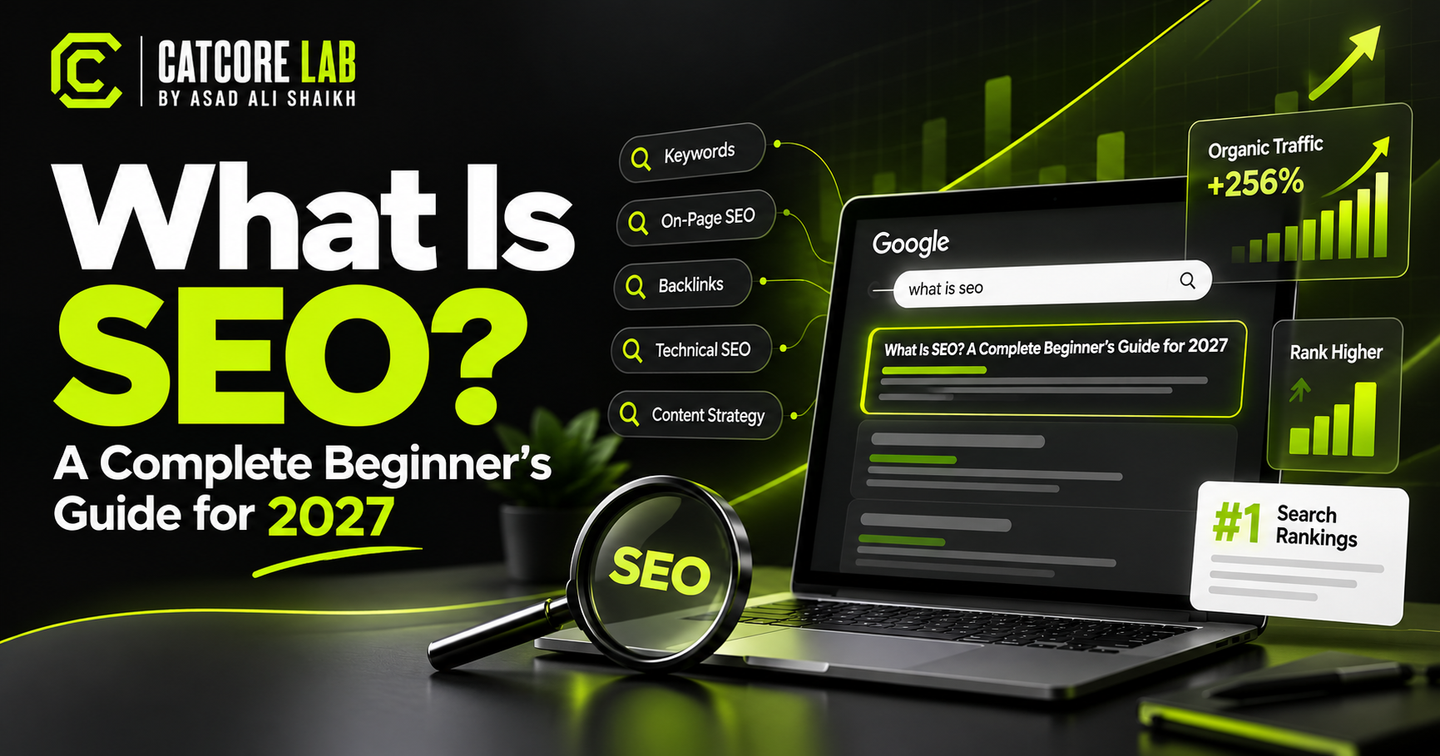
Search Engine Optimization (SEO) is the process of improving a website's visibility in organic (unpaid) search results. It helps search engines discover, understand, and display relevant webpages when people search for information, products, or services.
For example, when someone searches Google for "best digital marketing tools," the search engine identifies pages that may answer the query. Websites with helpful content, relevant information, accessible pages, and strong technical foundations have a better opportunity to appear in the results.
SEO is an important part of digital marketing because it helps businesses attract people who are already searching for related information.
As we approach 2027, SEO continues to evolve with artificial intelligence, Google AI Overviews, conversational search, and AI-powered answer engines.
This beginner-friendly guide explains what SEO is, how it works, its main types, ranking considerations, essential tools, and the latest developments in AI search optimization.
SEO stands for Search Engine Optimization.
It includes techniques that improve a website's accessibility, relevance, content quality, and visibility in search engine results.
The primary goal of SEO is to attract relevant organic visitors who may become readers, customers, subscribers, or leads.
For example, an online training institute can create educational content targeting searches such as:
By answering these questions, the website can reach people interested in learning about marketing.
Unlike paid advertising, websites do not pay search engines for each organic click. However, SEO still requires time, expertise, content development, and ongoing improvements.
Search engines such as Google use automated systems to discover and organize information available on the internet.
Google Search broadly involves three stages: crawling, indexing, and serving search results.
Crawling is the process through which search engines discover webpages.
Google uses automated crawlers, including Googlebot, to find publicly accessible content and follow links between pages.
For example, when a website publishes a new article, Google may discover it through internal links, external references, or an XML sitemap.
Clear website navigation and logical internal linking help search engines discover important pages.
However, crawling does not guarantee indexing.
Indexing happens when a search engine processes a webpage and considers storing its information in a searchable index.
Google analyzes elements such as text, images, page titles, and other relevant content.
Pages with technical restrictions, duplicate content, or insufficient value may not be indexed.
Website owners can use Google Search Console to monitor indexing status and identify potential problems.
When someone enters a query, Google's automated systems evaluate indexed pages and select results that appear relevant and useful.
These systems use numerous signals, and their importance varies depending on the search.
For example, someone searching for a recent technology update may benefit from fresh information, while someone researching basic SEO concepts may prefer a comprehensive educational guide.
SEO improves a website's chances of appearing in relevant search results, but it cannot guarantee a particular ranking.
Google explains this process in its official How Search Works documentation.
SEO helps businesses connect with audiences actively looking for information or solutions.
Here are its major benefits.
A well-optimized website can attract visitors through unpaid search results.
Useful evergreen content may continue receiving visits months or years after publication, provided it remains competitive and relevant.
Appearing for relevant searches introduces businesses to potential customers who may not already know their brand.
Consistent visibility can help build familiarity and support brand recognition.
Unlike paid advertisements, which generally stop receiving paid exposure when spending ends, organic content may continue attracting visitors.
However, maintaining rankings requires monitoring, improvements, and sometimes significant ongoing investment.
SEO can attract users at different stages of their decision-making journey.
Someone searching "what is digital marketing" may want basic information, while someone searching "digital marketing course in Pakistan" may be considering enrollment.
Businesses benefit when their content addresses both informational and commercial searches.
For example, Catcore Lab provides resources about AI marketing and a structured AI Digital Marketing Course in Pakistan for people interested in developing practical marketing skills.
SEO is commonly divided into four major categories: on-page SEO, off-page SEO, technical SEO, and local SEO.
On-page SEO involves optimizing individual webpages to improve their relevance, clarity, and usability.
Important practices include:
For example, an article targeting "what is SEO" should clearly explain the term near the beginning.
Repeating the keyword unnecessarily does not make content better. Search engines are designed to understand related concepts and natural language.
Off-page SEO focuses on external activities that may support a website's visibility, discovery, and reputation.
One important element is backlinks.
A backlink is a hyperlink from another website pointing to your website.
For example, when a respected publication links to an original research article, that link can help people discover the content and may contribute to search engine signals.
However, backlink quality and relevance matter more than simply collecting large numbers of links.
Google considers manipulative link-building schemes a violation of its spam policies.
Effective off-page SEO should prioritize original research, useful resources, legitimate partnerships, and naturally earned mentions.
Technical SEO ensures that a website is accessible and understandable to search engines.
Important technical elements include:
Crawlability: Allowing search engines to access important content.
Indexability: Ensuring pages intended for search results are eligible for indexing.
Website architecture: Organizing content logically.
Mobile usability: Making pages functional and readable on smartphones.
Core Web Vitals: Measuring loading performance, responsiveness, and visual stability.
Canonical URLs: Identifying preferred versions of duplicate or similar pages.
Structured data: Providing standardized information that may help search engines understand supported content types.
Technical SEO creates a foundation for content to perform effectively, although technical improvements alone do not guarantee higher rankings.
Local SEO improves visibility for searches connected to a geographical location.
Examples include:
Businesses with eligible physical locations or service-area operations can improve local visibility through accurate Google Business Profiles, appropriate categories, authentic customer reviews, and relevant location pages.
Local SEO is particularly useful for businesses serving specific cities or neighborhoods.
Keyword research is the process of discovering and evaluating search terms that people enter into search engines.
It helps marketers understand audience demand, search intent, and potential opportunities.
For example, a marketing education website might research:
Each keyword represents a different audience need.
Keyword research tools can estimate search volume, keyword difficulty, and related questions. These figures are estimates rather than guaranteed traffic.
Search intent describes what a person wants to accomplish through a search.
There are four commonly used categories.
Informational intent: The user wants information, such as "What is SEO?"
Navigational intent: The user wants to reach a particular website, such as "Google Search Console login."
Commercial intent: The user is comparing solutions, such as "Best SEO tools for beginners."
Transactional intent: The user wants to take action, such as "Enroll in digital marketing course."
Matching search intent is essential because even a well-written article may struggle if it does not answer what users actually need.
For informational keywords, explanations, examples, and practical steps are usually more useful than aggressive promotional content.
SEO content writing is the practice of creating useful content that addresses search intent while making information accessible to readers and search engines.
Effective SEO writing combines research, accuracy, readability, and logical organization.
A strong article should:
Content quality is particularly important as AI tools make large-scale text generation easier.
Publishing hundreds of generic articles does not automatically improve rankings.
Google's guidance emphasizes helpful, reliable, people-first content rather than material primarily created to manipulate search visibility.
AI can assist with research, outlines, and editing, but information should still be fact-checked and improved through human expertise.
For practical examples, explore how AI SEO tools can improve Google rankings and how marketers use artificial intelligence for content optimization.
Google uses complex automated ranking systems rather than a simple public checklist with fixed scoring weights.
Nevertheless, several areas remain important for effective SEO.
The webpage should directly address the user's query and provide useful information.
An article about SEO should explain concepts clearly rather than focusing primarily on unrelated topics.
Accurate, original information helps users make informed decisions.
Credible references, practical examples, and clearly explained concepts can strengthen content quality.
Search engines need access to important content.
Broken links, indexing restrictions, inaccessible navigation, and technical issues can create problems.
Websites should be mobile-friendly, easy to navigate, and reasonably fast.
Google's Core Web Vitals help assess loading performance, responsiveness, and visual stability.
Good performance supports user experience but does not guarantee better rankings.
Google discusses Experience, Expertise, Authoritativeness, and Trustworthiness (E-E-A-T) within its guidance on evaluating content quality.
These principles encourage publishers to provide trustworthy information and demonstrate relevant knowledge.
E-E-A-T is not a standalone numerical ranking score.
Providing accurate author information, credible sources, and genuine experience can strengthen the usefulness and credibility of a webpage.
Answer Engine Optimization (AEO) focuses on making content easy for answer-oriented search experiences to understand and present.
Traditional search often displays a collection of webpage links.
Modern search experiences may also provide featured snippets, summarized responses, and conversational answers.
AEO aims to present information in a clear structure that can help answer specific questions.
Use question-based headings when they match genuine user queries.
Provide concise answers before detailed explanations.
Define technical terms clearly.
Structure tutorials into logical steps.
Include relevant examples and trustworthy references.
For instance:
What is on-page SEO?
On-page SEO is the process of improving individual webpages through useful content, clear headings, relevant internal links, and other elements that help users and search engines understand the page.
This format is helpful for readers and may make information easier for automated systems to interpret.
However, no formatting technique guarantees placement in an answer feature.
Generative Engine Optimization (GEO) refers to practices intended to improve how content and brands are discovered, understood, and potentially referenced by generative AI systems.
AI-powered experiences can produce responses by synthesizing information from different sources.
GEO considers how a website might become a useful source for such responses.
Publish original insights: Include firsthand observations, research, and examples that provide value beyond generic explanations.
Demonstrate credibility: Use clear author information and support important claims with reliable sources.
Maintain accessible content: Make important information available in crawlable, well-structured webpages.
Use descriptive headings: Organize topics so readers and automated systems can understand the information.
Update outdated material: Review articles when technologies and industry practices change.
Use appropriate structured data: Implement supported markup accurately without expecting guaranteed AI citations.
GEO does not require abandoning traditional SEO.
Google's guidance on AI features and your website emphasizes that established SEO fundamentals remain relevant to its AI-powered search experiences.
It is also important to remember that different AI systems have different capabilities and source-selection processes. No method guarantees that a particular AI platform will cite a website.
Although these concepts overlap, their primary focus differs.
SEO: Improving a website's visibility in organic search results.
AEO: Making content understandable and useful for direct-answer search experiences.
GEO: Improving the potential discoverability and visibility of content within generative AI experiences.
Consider an educational article about digital marketing.
Traditional SEO can help the article appear in relevant Google results.
Clear definitions and question-based sections can support answer-oriented experiences.
Original research, credible information, and accessible content may support its usefulness as a source for generative AI systems.
For most businesses, the strongest approach combines good SEO fundamentals with clear explanations and distinctive, trustworthy content.
Search technology continues evolving, especially as artificial intelligence becomes more deeply integrated into search experiences.
The following developments deserve attention.
Google AI Overviews and AI Mode have introduced AI-generated answers and conversational search experiences.
These features may change how people explore information and interact with website links.
Businesses should continue creating useful content that offers value beyond a short summary.
AI-generated writing makes basic explanations easier to produce.
Original observations, real case studies, useful examples, and independent research can help distinguish content from generic alternatives.
A website that consistently publishes distinctive information may offer readers stronger reasons to visit.
Modern search systems can interpret relationships between topics and concepts.
Instead of repeatedly targeting minor keyword variations with nearly identical articles, publishers should build useful resources covering related questions.
For example, a central SEO guide can link to specialized articles about keyword research, technical SEO, AI tools, and website optimization.
This approach helps readers navigate related subjects.
AI tools increasingly support tasks such as content planning, keyword organization, research, reporting, and technical troubleshooting.
However, automated recommendations still require verification.
Businesses should avoid publishing inaccurate content simply because an AI tool generated it quickly.
Keyword rankings remain useful, but businesses should also measure clicks, impressions, organic conversions, engagement, and other meaningful outcomes.
As AI-driven search evolves, traffic patterns may change.
Organizations should focus on business results rather than treating rankings as their only measure of success.
These are developments to prepare for as 2027 approaches, not guarantees about what every search engine will prioritize.
Several tools can help beginners understand and improve SEO performance.
Google Search Console provides information about organic Google Search performance, indexing, sitemaps, and website issues.
It is free and especially valuable for website owners.
Google Analytics helps measure website traffic, user engagement, and conversions.
It helps marketers understand what visitors do after reaching a website.
Google Trends displays relative search interest across regions and periods.
It is useful for understanding seasonal patterns and comparing topics, although it does not provide exact monthly search volumes.
Semrush provides keyword research, competitor analysis, backlink analysis, and website auditing capabilities.
Ahrefs offers tools for exploring organic keywords, backlinks, technical issues, and competitor performance.
Google PageSpeed Insights helps evaluate website performance and identify technical improvements related to the user experience.
Beginners can start with free Google tools before investing in paid SEO platforms.
For additional marketing software recommendations, explore 15 Best AI Tools for Digital Marketing.
Learning SEO becomes easier when you apply concepts to a real website.
Follow these steps.
Step 1: Understand search engines. Learn the basics of crawling, indexing, and ranking.
Step 2: Identify your audience. Understand what users search for and which questions your website can answer.
Step 3: Research keywords. Find relevant search terms and evaluate their intent, demand, and competition.
Step 4: Create useful content. Write accurate, original articles that solve audience problems.
Step 5: Optimize webpages. Improve titles, headings, internal links, images, and website navigation.
Step 6: Check technical SEO. Review crawlability, indexability, mobile usability, and page performance.
Step 7: Monitor performance. Use Google Search Console and analytics to assess impressions, clicks, and conversions.
Step 8: Improve continuously. Update outdated information, resolve technical issues, and expand content where it genuinely benefits readers.
SEO is a continuous learning process. Practical experience is more valuable than memorizing hundreds of supposed ranking tricks.
SEO results vary depending on competition, website history, technical condition, content quality, and search demand.
Some technical changes may be recognized relatively quickly, while meaningful organic growth can take several months or longer.
New websites competing for broad keywords often require sustained investment before attracting consistent organic traffic.
There is no universal timeframe that guarantees ranking improvements.
Instead of expecting immediate results, marketers should track relevant search impressions, organic clicks, lead quality, and overall performance over time.
SEO and paid advertising serve different purposes.
SEO focuses on earning organic visibility through relevant content and website optimization.
Paid advertising, including Google Ads and Meta Ads, helps businesses reach audiences through purchased placements.
Paid campaigns can generate exposure soon after launch, while SEO typically requires more time to establish consistent results.
Both approaches require investment.
An effective digital marketing strategy often combines SEO for organic discovery with paid advertising for more immediate reach, testing, and lead generation.
Understanding both channels helps marketers make better business decisions.
Yes. Many important SEO skills do not require programming knowledge.
Beginners can learn keyword research, search intent analysis, content optimization, internal linking, and basic SEO reporting without writing code.
However, HTML, website structure, redirects, and JavaScript rendering become increasingly useful when working on technical SEO projects.
Start with the fundamentals, build practical experience, and gradually develop technical knowledge.
SEO is one of several valuable skills within modern digital marketing.
Professionals also benefit from understanding content marketing, paid advertising, audience targeting, analytics, conversion funnels, and artificial intelligence.
Catcore Lab offers an AI Digital Marketing Course in Pakistan designed to introduce beginners to practical marketing concepts.
The eight-week live online program covers areas including Meta Ads, Google Ads, AI tools, content strategy, marketing funnels, and analytics.
Students interested in structured training can explore the course curriculum and enrollment details.
You can also read Can You Learn Digital Marketing in 2 Months? to understand realistic learning expectations and the importance of hands-on practice.
SEO is the process of improving a website so people can discover its content through relevant unpaid search engine results.
The four commonly discussed types are on-page SEO, off-page SEO, technical SEO, and local SEO.
Organic clicks do not require payment to search engines, but SEO work may involve spending on content, tools, website development, and professional expertise.
Basic SEO concepts are accessible to beginners. More advanced skills, especially technical SEO and competitive strategy, require practice and ongoing learning.
SEO is expected to remain relevant as search engines and AI-powered discovery systems continue helping users find information. However, specific search features and optimization techniques may evolve.
Digital marketing is the broader discipline of promoting products, services, and brands through digital channels. SEO is one part of digital marketing, focused on organic search visibility.
AI can automate or assist with certain SEO activities, but it does not eliminate the need for useful content, reliable information, technical accessibility, or human judgment.
There is no fixed number. Content should address one clear primary search intent and naturally cover relevant supporting questions without keyword stuffing.
Google Search Console is an excellent free starting point for website owners because it provides direct information about their performance and indexing in Google Search.
No. Search rankings depend on multiple automated systems, competition, relevance, and other factors. No ethical SEO strategy guarantees a specific position.
Search Engine Optimization remains an essential part of digital marketing in 2027. It helps businesses improve organic visibility, reach relevant audiences, and create long-term opportunities through useful online content.
Beginners should focus on understanding how search engines work, the four main types of SEO, keyword research, search intent, content quality, and technical fundamentals.
As AI-powered search continues evolving, AEO and GEO provide additional ways to think about content discoverability. However, reliable information, original insights, accessible websites, and strong SEO fundamentals remain the most practical foundation.
If you want to explore how SEO fits into a wider marketing strategy, visit Catcore Lab and discover its AI Digital Marketing Course to begin developing practical digital marketing skills.
Learn how to use AI SEO tools for keyword research, content optimization and technical audits to improve your website’s Google rankings.
Read articleCan you learn digital marketing in 2 months? Explore practical skills, an 8-week roadmap, student reviews, and Catcore Lab's AI Digital Marketing Course.
Read articleDiscover digital marketing salary in Pakistan for 2026–2027, including fresher, specialist, SEO, performance marketing and senior-level earnings.
Read article