
AI Digital Marketing
What Is Digital Marketing? Complete Beginner’s Guide for 2027
Learn what digital marketing is, how it works, its main types, benefits, examples, and skills beginners need in 2026 and heading into 2027.
Read article
Can you learn digital marketing in 2 months? Explore practical skills, an 8-week roadmap, student reviews, and Catcore Lab's AI Digital Marketing Course.
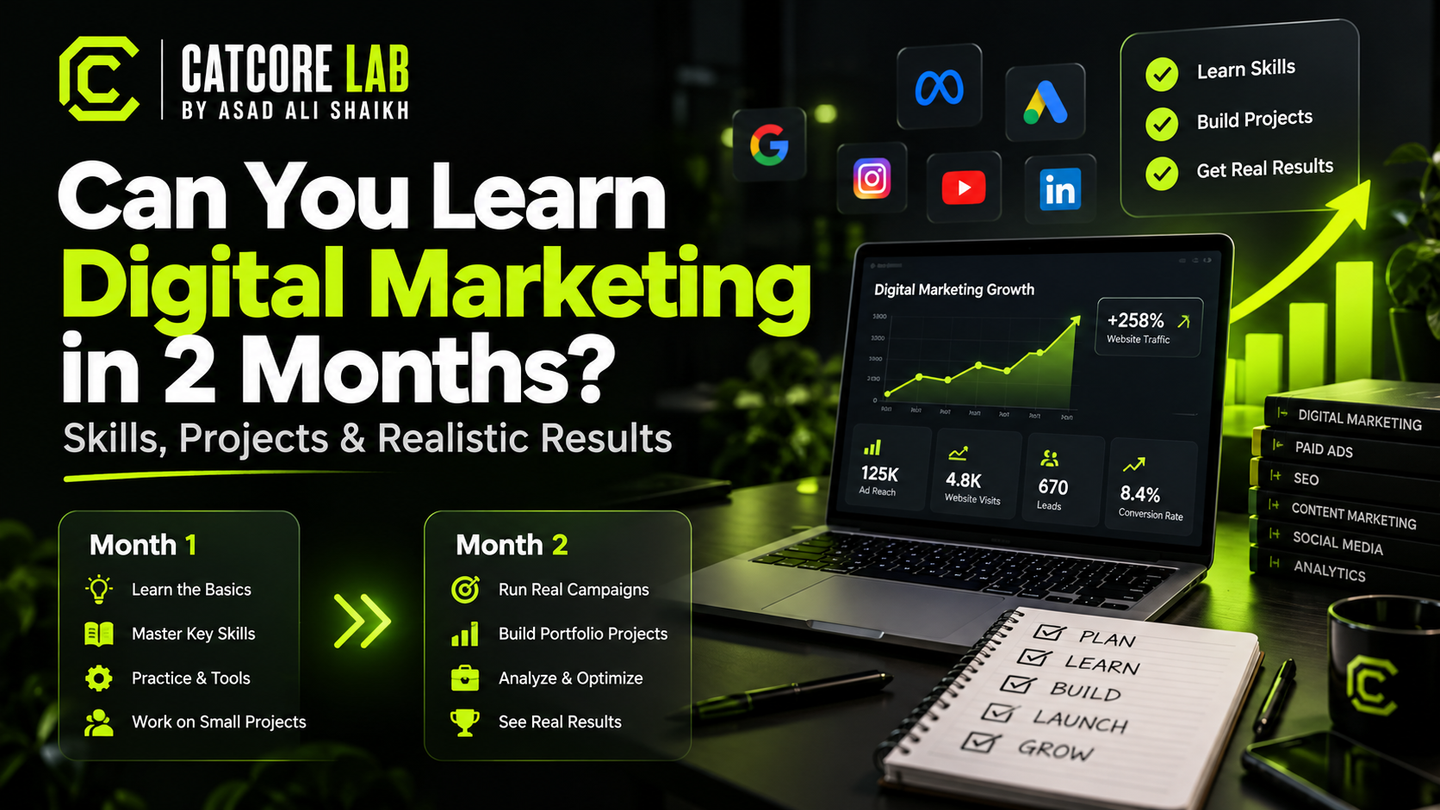
Can you really learn digital marketing in just two months? It's one of the most common questions beginners ask before starting their digital marketing journey. With so many platforms, marketing strategies, advertising tools, and AI technologies available today, learning everything in eight weeks might seem impossible.
The answer is yes, you can build a strong foundation in digital marketing in two months, provided you follow a structured learning plan, practice consistently, and work on relevant projects.
However, there is an important difference between learning digital marketing and becoming an experienced digital marketing professional. Eight weeks can introduce you to essential skills, help you understand how campaigns work, and prepare you to start building a practical portfolio. Expertise comes from applying those skills repeatedly.
For students, freelancers, job seekers, and business owners in Pakistan, an intensive learning program can provide a valuable starting point.
At Catcore Lab, the 8-week AI Digital Marketing Course in Pakistan combines live online classes, practical learning, AI-powered marketing tools, and real campaign workflows to help beginners develop industry-relevant skills.
Let's explore what you can realistically learn in two months, which projects you should complete, and how structured training can help you take your first steps into digital marketing.
Two months can be enough to understand digital marketing fundamentals and develop basic practical skills, but it is not enough to master every marketing discipline.
Digital marketing includes several interconnected areas, such as social media marketing, search advertising, content strategy, search engine optimization, performance analytics, marketing funnels, and customer acquisition.
A beginner does not need to become an expert in all these areas immediately.
Instead, the first goal should be understanding how these channels work together to attract potential customers and generate meaningful business results.
For example, imagine a clothing brand wants to increase online sales.
A digital marketer might begin by researching the target audience, developing social media content, creating a Meta Ads campaign, directing potential customers to a website, and monitoring conversions.
Each activity requires a specific skill, but the entire process follows one connected marketing strategy.
In an eight-week learning program, students can begin understanding these connections and practicing individual tasks.
However, mastering campaign optimization, managing large advertising budgets, acquiring clients, and developing advanced marketing strategies generally requires further experience.
If you're completely new to the industry, start with our beginner's guide to digital marketing to understand its fundamentals.
A well-structured digital marketing course should focus on practical skills that businesses and marketing teams actually use.
Here are some of the important areas beginners can explore during their first two months.
Social media marketing is often one of the easiest starting points for beginners.
Students can learn how businesses use Facebook, Instagram, and other platforms to communicate with audiences, build brand awareness, and promote products or services.
More importantly, they should understand that successful social media marketing involves more than publishing attractive posts.
It requires audience research, content planning, brand messaging, and performance analysis.
During their initial learning journey, students can practice creating content calendars, writing engaging captions, identifying customer interests, and organizing content around specific marketing objectives.
For example, a student might develop a seven-day social media content strategy for a local restaurant or clothing brand.
This provides a practical introduction to marketing planning.
Paid advertising is another valuable digital marketing skill.
Meta Ads allows businesses to promote products and services across Facebook, Instagram, and other placements.
Beginners can learn how advertising objectives work, how audiences are selected, and how campaigns are structured.
They can also explore essential advertising metrics, including:
Understanding these metrics helps students distinguish between advertisements that generate attention and campaigns that produce business results.
A useful beginner project is creating a sample Meta Ads campaign, including the audience, objective, budget, advertising copy, and creative concept.
Google Ads introduces students to advertising based on search intent.
Unlike many social media campaigns, Google Search Ads can reach people who are actively looking for a particular product or service.
For example, someone searching for "digital marketing course in Pakistan" may already be comparing educational programs.
Students can learn how keywords, search intent, advertising copy, campaign structure, and landing pages influence advertising performance.
They can also practice creating keyword lists and planning sample search campaigns.
Learning Google Ads alongside Meta Ads provides a broader understanding of paid digital advertising.
Artificial intelligence has become an important part of modern digital marketing.
Tools such as ChatGPT, Gemini, Claude, and Canva can support marketers with research, content ideas, creative planning, and repetitive tasks.
However, knowing how to generate AI content is not the same as understanding marketing.
Students must learn how to use AI responsibly while making their own strategic decisions.
For example, AI can help generate multiple advertising headlines, but a marketer must still evaluate which message matches the audience, business objective, and brand identity.
Beginners can practice using AI for:
You can also explore our guide to the 15 best AI tools for digital marketing to discover useful platforms and their applications.
One of the most important lessons beginners should learn is that marketing does not end when someone clicks an advertisement.
Businesses need to guide potential customers from discovering a product to making a purchasing decision.
This process is commonly explained through marketing funnels.
For example, someone might discover a course through Instagram, visit its website, read student reviews, compare the curriculum, and finally enroll.
Each stage requires different marketing communication.
Students who understand marketing funnels can begin connecting advertising, content, websites, and customer behavior into a complete strategy.
Read our detailed article on marketing funnels, stages, and examples to understand how this process works.
Digital marketing becomes much more effective when marketers can measure results.
Instead of focusing only on likes, impressions, or website visitors, students should learn which actions actually contribute to business goals.
A campaign might generate thousands of clicks but very few purchases.
Another campaign might attract fewer visitors but generate more qualified leads.
Understanding that difference is essential.
During the first two months, beginners can become familiar with analytics dashboards, website traffic, conversion events, and campaign performance reports.
Learning to interpret basic performance data builds the foundation for more advanced marketing decisions.
If you're starting from zero, following a structured roadmap can make the learning process more manageable.
The following is an example of how beginners can organize their first eight weeks. It is an illustrative learning plan, not the exact lecture-by-lecture schedule of any particular course.
Start by learning how digital marketing works, how businesses attract customers online, and how different marketing channels contribute to growth.
Focus on target audiences, customer journeys, marketing objectives, and basic terminology.
Explore content planning, audience research, social media platforms, and brand communication.
Practice project: Prepare a seven-day content calendar for a business.
Learn campaign objectives, advertising structure, targeting, budgets, creatives, and performance metrics.
Practice project: Develop a sample Facebook and Instagram advertising campaign.
Explore search intent, keyword research, campaign organization, and advertising copy.
Practice project: Build a sample Google Search campaign plan.
Learn how AI can support research, content production, advertising ideas, and marketing workflows.
Practice project: Develop an AI-assisted marketing content plan and evaluate the generated outputs.
Learn how businesses convert attention into leads and sales through landing pages, forms, messaging, and customer journeys.
Practice project: Design a basic customer acquisition funnel.
Explore performance metrics, conversion tracking, reporting, and campaign improvement.
Practice project: Analyze a sample marketing performance report and recommend improvements.
Combine the skills learned during previous weeks into one practical campaign plan.
The final project might include audience research, content strategy, advertising ideas, creative samples, a simple funnel, and a measurement plan.
By the end of these eight weeks, a dedicated beginner should have a clearer understanding of how digital marketing campaigns are developed and managed.
The next step is continuing to practice those skills.
One common mistake beginners make is spending too much time watching lessons without applying what they learn.
Watching someone create an advertising campaign is useful, but creating your own campaign plan develops a different level of understanding.
Practical projects encourage students to make decisions.
They must identify an audience, select a marketing objective, choose suitable platforms, create messages, and explain how results would be measured.
Even simulated campaigns can help beginners develop valuable skills when the assumptions and limitations are clearly documented.
For example, a student interested in freelancing could prepare a complete social media strategy for a small business.
Another student might design a lead-generation funnel for an educational institute.
These projects can become part of an initial portfolio, provided they are clearly labeled as practice work rather than paid client results.
This is why practical assignments and instructor feedback are valuable components of structured digital marketing education.
Completing a two-month digital marketing course can help you prepare for entry-level opportunities, but it does not automatically qualify you for every digital marketing role.
Employers often evaluate a combination of practical skills, communication abilities, problem-solving, and previous experience.
Beginners who complete relevant projects may be better prepared to apply for internships, junior marketing positions, or supervised campaign-support roles.
Some potential starting points include:
The exact opportunities available depend on your skills, local market conditions, and the requirements of individual employers.
It is also important to understand that a certificate alone does not guarantee employment.
For a better understanding of career opportunities, read our Digital Marketing Salary in Pakistan 2026–2027 guide.
You can also follow our AI Digital Marketer Career Roadmap to explore the steps involved in developing a long-term career.
Yes, beginners can start preparing for freelancing after developing foundational digital marketing skills.
However, attracting paying clients requires more than completing a course.
Freelancers need to demonstrate their abilities, understand client requirements, communicate professionally, and deliver reliable work.
A beginner might start with a manageable service such as social media content planning, basic keyword research, or marketing reporting support.
Instead of promising a complete marketing transformation, it is better to offer a clearly defined service that matches your current skill level.
For example, a beginner could create a sample social media content calendar for a local business and use it to demonstrate their planning abilities.
As their skills improve, they can gradually take on more complex responsibilities.
Building a portfolio, requesting constructive feedback, and continuing to learn can strengthen the chances of securing opportunities.
For learners who prefer structured guidance instead of navigating hundreds of unrelated online tutorials, Catcore Lab's AI Digital Marketing Course in Pakistan offers a live online learning experience.
The program is designed for beginners, students, freelancers, business owners, and working professionals interested in developing modern digital marketing skills.
Rather than focusing exclusively on one advertising platform, it introduces learners to multiple parts of the digital marketing process.
The program covers areas such as social media marketing, Meta Ads, Google Ads, AI tools and prompt engineering, content strategy, marketing funnels, WhatsApp marketing, analytics, conversion tracking, and AI-supported website workflows.
The goal is to help learners understand how these skills connect in practical marketing environments.
Students participate in live online sessions, explore marketing tools, engage with learning exercises, and receive guidance throughout the program.
Course materials, recordings, and learning resources support students who need to revisit important concepts.
Course Name: AI Driven Digital Marketing
Institute: Catcore Lab
Lead Trainer: Asad Ali Shaikh
Duration: 8 Weeks (2 Months)
Total Classes: 16 Live Online Classes
Class Schedule: Saturday and Sunday, 5:00 PM to 7:00 PM (Pakistan Standard Time)
Class Format: Live and Interactive Online Training
Experience Required: Beginner Friendly
Learning Resources: Class Recordings, Course Materials, and Practical Exercises
Certificate: Verifiable Catcore Lab Certificate for Eligible Graduates
Upcoming Batch: 12 December 2026
Current Early-Bird Course Fee: PKR 15,999 until 31 October 2026
Planned Fee After Early Bird: PKR 17,999
Course dates, fees, and enrollment conditions are subject to the details displayed on the official course page at the time of registration.
The training is led by Asad Ali Shaikh, founder and CEO of Catcore Solutions.
With more than a decade of marketing and business experience, including work involving markets in Pakistan, the UAE, and the USA, he brings practical industry knowledge into the learning environment.
For beginners, learning from an instructor who understands campaign planning, business objectives, and real-world marketing challenges can provide useful context beyond technical demonstrations.
The focus is not simply on memorizing advertising terminology.
Students are encouraged to understand why particular marketing decisions are made, how strategies are developed, and which metrics matter when evaluating performance.
When choosing a digital marketing course, one of the most useful things prospective students can do is review feedback from people who have already attended.
Student reviews can provide insight into the teaching approach, class environment, instructor support, and practical learning experience.
Rather than relying only on promotional claims, prospective learners should look for specific feedback about what students learned, which assignments they completed, and how confidently they can apply those skills.
Student Review 1 — Learning Experience
A great place to learn Digital Marketing and Website Development in Karachi. Catcore Lab covers everything from website building, landing pages and SEO to Meta Ads, Google Ads, Analytics, AI Tools and Lead Generation. The sessions are easy to understand and focused more on implementation than just theory. Definitely worth checking out if you want to learn modern digital marketing skills.
Student Review 2 — Practical Skills and Assignments
I’m very glad I took the AI-Driven Digital Marketing course. It was an insightful and practical learning experience. The instructor’s expertise and real-world experience made the concepts easy to understand and apply. I gained valuable knowledge and truly enjoyed the entire learning journey.
Student Review 3 — Instructor Support and Confidence
Good course for beginners. I had no previous experience but now I can understand digital marketing basics, content creation and retargeting. The course was well organized and the support was good. Recommended.
These experiences can help future students understand what attending Catcore Lab is actually like.
They should also be considered alongside the course syllabus, delivery format, practical requirements, and individual learning goals.
A strong student testimonial is not necessarily one that promises exceptional income or immediate employment.
Often, the most valuable feedback describes a meaningful improvement in knowledge or confidence.
For example, a student who previously found Meta Ads Manager confusing might describe how guided practice helped them understand campaign structure.
Another student may explain how learning content planning helped them organize their marketing work more effectively.
These are examples of useful feedback themes, not statements attributed to actual Catcore Lab students.
Prospective learners should evaluate genuine, verifiable reviews and remember that individual experiences and outcomes can vary.
An intensive digital marketing course can be valuable for different types of learners, depending on their goals.
Students who want to explore marketing careers can develop foundational knowledge and begin preparing practical projects before applying for entry-level opportunities.
Freelancers who already offer design, writing, or related services may use digital marketing training to understand additional services such as content strategy or advertising support.
Business owners can benefit from understanding customer acquisition, advertising metrics, marketing funnels, and campaign evaluation.
Even if they eventually hire marketing professionals, these skills can help them ask better questions and evaluate marketing decisions.
Professionals considering a career transition can use structured training to explore digital marketing without immediately committing to a long academic program.
The weekend format can also be convenient for learners managing studies or employment during weekdays.
Simply enrolling in a digital marketing course is not enough.
Students should approach the learning process with clear goals and a willingness to practice.
Attend live classes regularly, ask questions whenever a concept is unclear, complete assignments, and revisit difficult topics through available recordings.
Rather than trying to master every tool immediately, focus on understanding why each platform is used.
For example, learning how Meta Ads Manager works is useful, but understanding when a business should use Meta Ads is equally important.
Students should also maintain a record of their completed projects.
Saving campaign plans, content calendars, creative examples, and performance analyses can help them demonstrate their progress later.
After completing the course, choose one area that interests you most and continue developing it.
Specialization becomes easier when you already understand how different marketing disciplines work together.
Yes. Beginners can develop foundational knowledge of social media marketing, advertising, AI tools, analytics, and marketing strategy within two months of structured learning. Becoming professionally proficient requires continued practice.
It can help you develop initial skills and create practice projects. However, freelance success depends on service quality, communication, portfolio strength, client acquisition, and experience.
Follow a structured learning roadmap, practice consistently, complete meaningful projects, and seek constructive feedback. Avoid spending all your time watching tutorials without applying the lessons.
You can learn their fundamentals, understand campaign structure, and practice basic planning within two months. Advanced optimization and consistent campaign performance require more experience.
Yes. Beginners can learn how AI supports marketing research, content creation, campaign planning, and analysis. However, it is important to learn marketing principles alongside AI tools.
Yes. Catcore Lab offers a live online AI Digital Marketing Course designed for learners across Pakistan, including Karachi, Lahore, Islamabad, and other cities.
The course runs for eight weeks and includes 16 live online classes, typically conducted on Saturdays and Sundays from 5:00 PM to 7:00 PM Pakistan time.
Yes. Eligible graduates receive a verifiable Catcore Lab certificate after fulfilling the applicable course completion requirements.
Recordings are included as part of the advertised course resources, allowing students to revisit lessons according to the applicable access conditions.
As of October 2026, the advertised early-bird fee is PKR 15,999 until 31 October 2026, with a planned subsequent fee of PKR 17,999. Check the official course page for the latest applicable pricing.
The currently advertised upcoming batch begins on 12 December 2026, subject to any officially announced schedule changes.
Learning digital marketing in two months is possible when your goal is to build strong fundamentals, understand essential marketing tools, and develop initial practical skills.
However, completing an eight-week program should be viewed as the beginning of your professional development rather than the end.
The most valuable learners are not necessarily those who know the largest number of tools. They are the ones who understand marketing problems, practice consistently, and develop the ability to make informed decisions.
Whether you want to explore a new career, start freelancing, improve your business's online presence, or learn AI-powered marketing techniques, structured education can help you begin with greater clarity.
Ready to take your first step?
Explore the Catcore Lab AI Digital Marketing Course to review the complete curriculum, live class schedule, practical learning approach, student experience, and current enrollment details.
Your first eight weeks do not have to make you an expert. They can help you build the foundation for everything you learn next.
Learn what digital marketing is, how it works, its main types, benefits, examples, and skills beginners need in 2026 and heading into 2027.
Read articleLearn what a marketing funnel is, how each stage works, examples of TOFU, MOFU and BOFU, and how businesses turn prospects into customers.
Read articleDiscover 15 of the best AI tools for digital marketing in 2026 for SEO, content, social media, ads, research and marketing automation.
Read article
