
AI Digital Marketing
What Is a Marketing Funnel? Stages, Examples & How It Works
Learn what a marketing funnel is, how each stage works, examples of TOFU, MOFU and BOFU, and how businesses turn prospects into customers.
Read article
Learn what digital marketing is, how it works, its main types, benefits, examples, and skills beginners need in 2026 and heading into 2027.
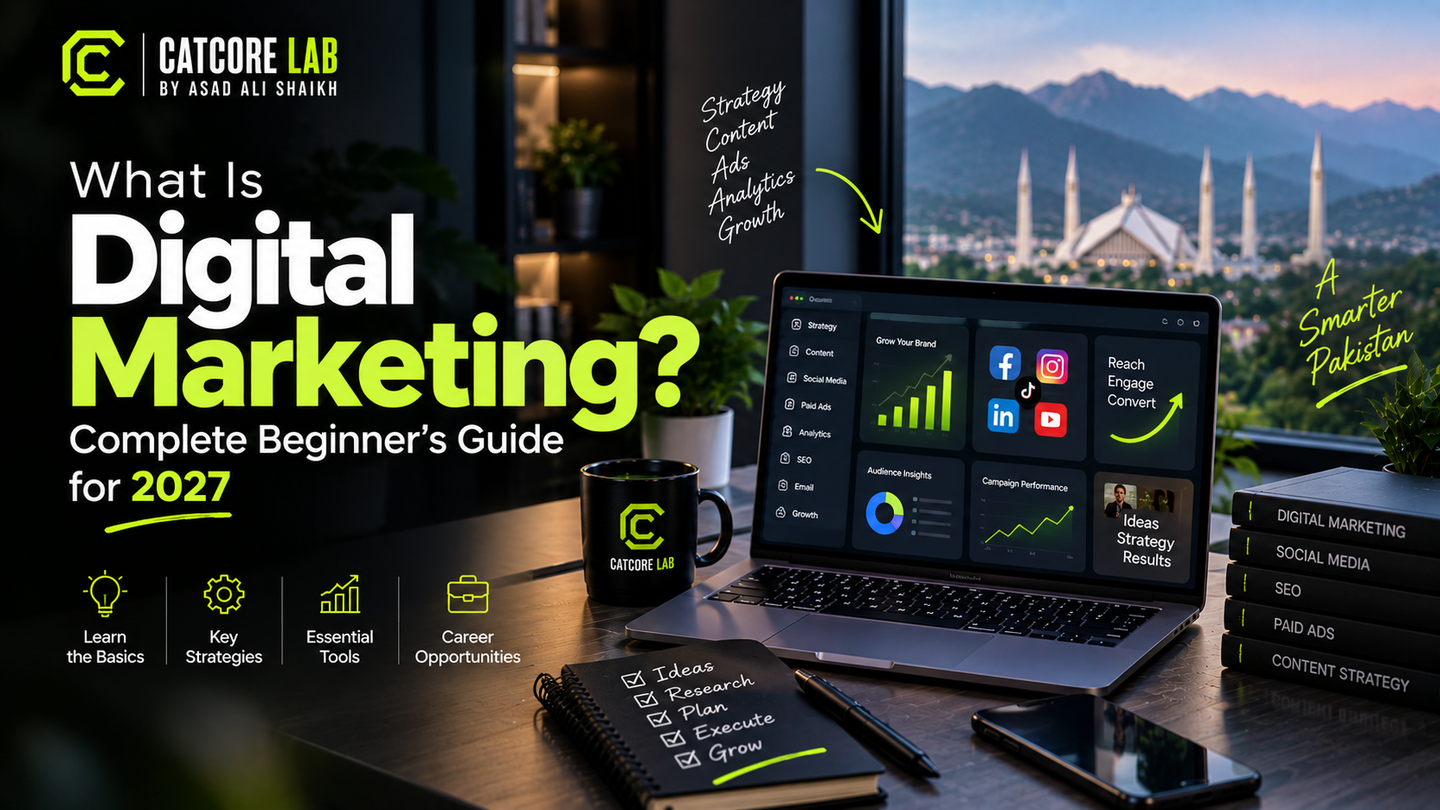
Digital marketing is the process of promoting a business, product or service through digital channels such as search engines, websites, social media, email, online advertising and mobile platforms. Its purpose is to reach the right audience, build awareness, generate leads, drive sales and measure results through digital data.
As 2026 moves toward 2027, digital marketing is becoming even more connected with artificial intelligence, automation, advanced analytics and personalized customer experiences. However, the core principle remains the same: businesses need to understand their customers and reach them through the right message, channel and timing.
If you have ever discovered a business through Google, clicked an Instagram ad, watched a branded YouTube video, received a promotional email or bought something after reading an online review, you have already experienced digital marketing in action.
Digital marketing works by connecting businesses with potential customers through the online platforms they already use. These platforms may include Google, Instagram, Facebook, YouTube, websites, email inboxes or mobile applications.
For example, someone interested in learning marketing may first search Google for “what is digital marketing.” They may then read an article, watch a video, follow a brand on social media and later visit a course or service page before making a decision.
Each touchpoint serves a different purpose. Search may create discovery, content builds understanding, social media builds familiarity, and a website or landing page may eventually turn interest into a lead or customer.
For a practical example of how AI, content, advertising, websites and tracking can work together, explore Catcore Lab’s AI Digital Marketing Course in Pakistan.
Digital marketing is not one single activity. It includes several different channels and strategies, and each one plays a specific role depending on the business objective and customer journey.
A strong digital marketing strategy often combines multiple channels instead of depending entirely on one platform. For example, SEO can bring organic traffic while social media builds awareness and paid ads generate faster reach.
SEO is the process of improving a website so that it can appear more prominently in organic search engine results. The goal is to help the right people discover relevant content, products or services without paying for every click.
SEO normally involves keyword research, search intent, content quality, technical optimization, internal linking, backlinks and overall website structure. Unlike paid advertising, SEO can continue bringing traffic after the initial work has been done, although strong rankings usually take time.
Content marketing focuses on creating useful information that attracts, educates and builds trust with potential customers. Blog posts, videos, guides, case studies, tutorials and podcasts are all common forms of content marketing.
This article itself is a good example. Instead of directly trying to sell something, it answers a question that people are already searching for and helps them understand the topic before they make a decision.
If you want to see how AI can support modern marketing workflows, read our guide to the best AI tools for digital marketing.
Social media marketing uses platforms such as Instagram, Facebook, LinkedIn, TikTok and YouTube to connect with audiences. It can include both organic content and paid advertising.
Organic social media focuses on content, community and brand awareness, while paid social media allows businesses to target specific groups with advertisements. In 2026, short-form video, creator-led content and platform-native storytelling remain major parts of social media strategy.
Pay-per-click advertising, commonly known as PPC, allows businesses to pay for visibility across digital platforms. Google Ads and Meta Ads are two of the most common examples.
Google Ads often captures users who are actively searching for something, while Meta Ads can reach audiences across Facebook and Instagram based on interests, behaviors and platform signals. Paid ads can generate faster results than SEO, but they require strong creative, targeting and conversion tracking.
Email marketing allows businesses to communicate directly with people who have joined an email list or already become customers. It is often used for promotions, educational content, reminders, onboarding and retention.
One major advantage of email is ownership. Unlike social media, where reach can depend on algorithms, an email list gives businesses a more direct way to communicate with their audience.
A website is often the place where different digital marketing channels come together. Someone may discover a brand on Instagram, research it on Google and eventually complete a purchase or form submission on the website.
A strong website should clearly explain what the business offers, who it is for, why the visitor should trust it and what action they should take next. Traffic alone is not enough if the website does not convert visitors.
One of the strongest advantages of digital marketing is the ability to measure performance. Businesses can track impressions, clicks, leads, purchases, conversion rates, cost per lead and return on advertising spend.
Tools such as Google Analytics help marketers understand how users interact with websites and campaigns. Instead of only asking how many people saw an ad, marketers can ask what happened after people saw it.
A digital marketing strategy is a structured plan that explains how a business will use digital channels to achieve specific goals. It connects content, advertising, websites, search, social media and analytics into one system.
A good strategy starts with the audience. Businesses need to understand who their customers are, what problems they have, which platforms they use and what information they need before making a decision.
Without strategy, businesses often end up posting randomly, running ads without clear goals and publishing content without understanding how those activities contribute to sales or brand growth.
Imagine a skincare brand launching a new product in 2026. The brand publishes SEO articles answering common skincare questions, creates educational Instagram Reels and runs Meta Ads to introduce products to new audiences.
At the same time, Google Ads target people already searching for skincare solutions. Visitors land on optimized product pages, while people who leave without purchasing may later see retargeting ads.
After a purchase, the brand can use email marketing to follow up, request feedback or recommend related products. Analytics then helps the business understand which channels actually produced sales.
Digital marketing allows businesses to reach both local and global audiences while measuring performance more accurately than many traditional advertising methods.
It also allows companies to target specific groups, test different messages, adjust budgets quickly and collect data on customer behavior. This flexibility makes digital marketing valuable for both small businesses and larger companies.
In 2026 and heading into 2027, automation and AI are making these processes even faster. However, businesses still need a clear strategy because better technology cannot fix weak positioning or an unclear offer.
Traditional marketing includes channels such as television, radio, newspapers, magazines, billboards and printed material. Digital marketing operates through websites, search engines, social platforms, email and online advertising.
The biggest difference is usually measurement and targeting. A billboard may be seen by thousands of people, but it can be difficult to know exactly how many later became customers.
Digital campaigns can often track a much clearer journey from an impression to a click, lead or purchase. This does not make traditional marketing useless, but digital channels generally provide more detailed performance data.
Artificial intelligence has become one of the biggest changes in digital marketing during 2026. Marketers are increasingly using AI for research, content ideas, customer analysis, campaign planning, automation, creative development and reporting.
As businesses move into 2027, AI is likely to become even more integrated into everyday workflows. The focus is shifting from simply generating content to using AI for better decision-making, workflow automation and customer personalization.
However, AI does not replace marketing knowledge. A tool can generate ten ads in seconds, but a marketer still needs to decide whether the offer is strong, whether the audience is correct and whether the campaign is profitable.
For a deeper look at this topic, read A Complete Guide to AI Digital Marketing Course in Pakistan.
Modern digital marketers do not need to master every platform, but they should understand how the main areas connect. Important skills include customer research, content strategy, SEO, social media marketing, Meta Ads, Google Ads, analytics and conversion tracking.
Website fundamentals, marketing funnels and AI-assisted workflows are also becoming increasingly important. Platforms will continue changing, but marketers who understand the logic behind a strategy can adapt much more easily.
Communication, critical thinking and data interpretation are also essential. These skills help marketers understand why a campaign worked instead of simply knowing which buttons were clicked inside an advertising dashboard.
Digital marketing can be a strong career option because businesses continue to need people who can help them attract and convert customers online.
Career paths include SEO, social media marketing, paid advertising, content marketing, email marketing, performance marketing, analytics and marketing automation.
Beginners do not need to choose a specialization immediately. It is usually better to learn the fundamentals first, work on practical projects and then decide which area matches their strengths.
If you are considering this field professionally, read our guide on how to become an AI digital marketer in Pakistan.
Beginners should avoid trying to learn every platform at once. Start with the fundamentals of customer behavior, marketing strategy and content before moving into technical areas.
Once those foundations are clear, learn SEO, social media, Meta Ads, Google Ads, websites, analytics and conversion tracking. AI tools can then be added to make research, content and analysis faster.
The goal should not be to memorize software. The goal should be to understand how marketing works, because tools and platforms will continue changing from 2026 into 2027 and beyond.
For structured practical learning, you can explore Catcore Lab’s live AI Digital Marketing program, which combines AI, advertising, content, websites, analytics and conversion tracking.
Digital marketing is the process of using online channels to connect businesses with customers and move them toward a meaningful action. It includes SEO, content, social media, paid advertising, websites, email and analytics.
In 2026, digital marketing is already heavily influenced by AI and automation, and this shift will continue into 2027. However, the fundamentals of customer understanding, strategy, communication and measurement will remain important.
For beginners, the best approach is simple: learn the fundamentals first, understand how the channels connect and then use AI and automation to work faster and make better decisions.
Digital marketing means promoting a business, product or service through online channels such as Google, websites, social media, email and digital advertising.
The main types of digital marketing include SEO, content marketing, social media marketing, PPC advertising, email marketing, website marketing and marketing automation.
A business publishing SEO content, running Instagram Ads, sending promotional emails and tracking website sales is using digital marketing.
Digital marketing reaches potential customers through online channels, provides useful information or offers and then guides them toward actions such as visiting a website, submitting a form or making a purchase.
Yes. SEO is an important part of digital marketing because it helps websites appear in organic search results when people search for relevant topics, products or services.
Yes. Social media marketing is one branch of digital marketing. Digital marketing also includes SEO, Google Ads, email marketing, websites, content and analytics.
Digital marketing is the broader field, while social media marketing focuses specifically on platforms such as Facebook, Instagram, LinkedIn, TikTok and YouTube.
Yes. Beginners can start with marketing fundamentals, content, social media and basic SEO before moving into paid advertising, analytics and advanced tools.
No. Most digital marketing roles do not require coding. Basic knowledge of websites and tracking can be useful, but programming is not necessary for most beginners.
AI is used for research, content ideas, copywriting, data analysis, automation, creative development and customer support. In 2026, these use cases are becoming increasingly common across marketing teams.
Yes. Businesses will continue using websites, search engines, social media, paid advertising, email and analytics to reach customers. AI is changing how marketers work, but it does not remove the need for marketing skills.
Beginners should start with customer understanding, content strategy, social media, SEO and analytics. They can then progress to Meta Ads, Google Ads, funnels, conversion tracking and AI-assisted marketing.
Learn what a marketing funnel is, how each stage works, examples of TOFU, MOFU and BOFU, and how businesses turn prospects into customers.
Read articleDiscover 15 of the best AI tools for digital marketing in 2026 for SEO, content, social media, ads, research and marketing automation.
Read articleLearn how to become an AI digital marketer in Pakistan in 2026, the skills you need, useful AI tools, career options and a practical roadmap.
Read article
