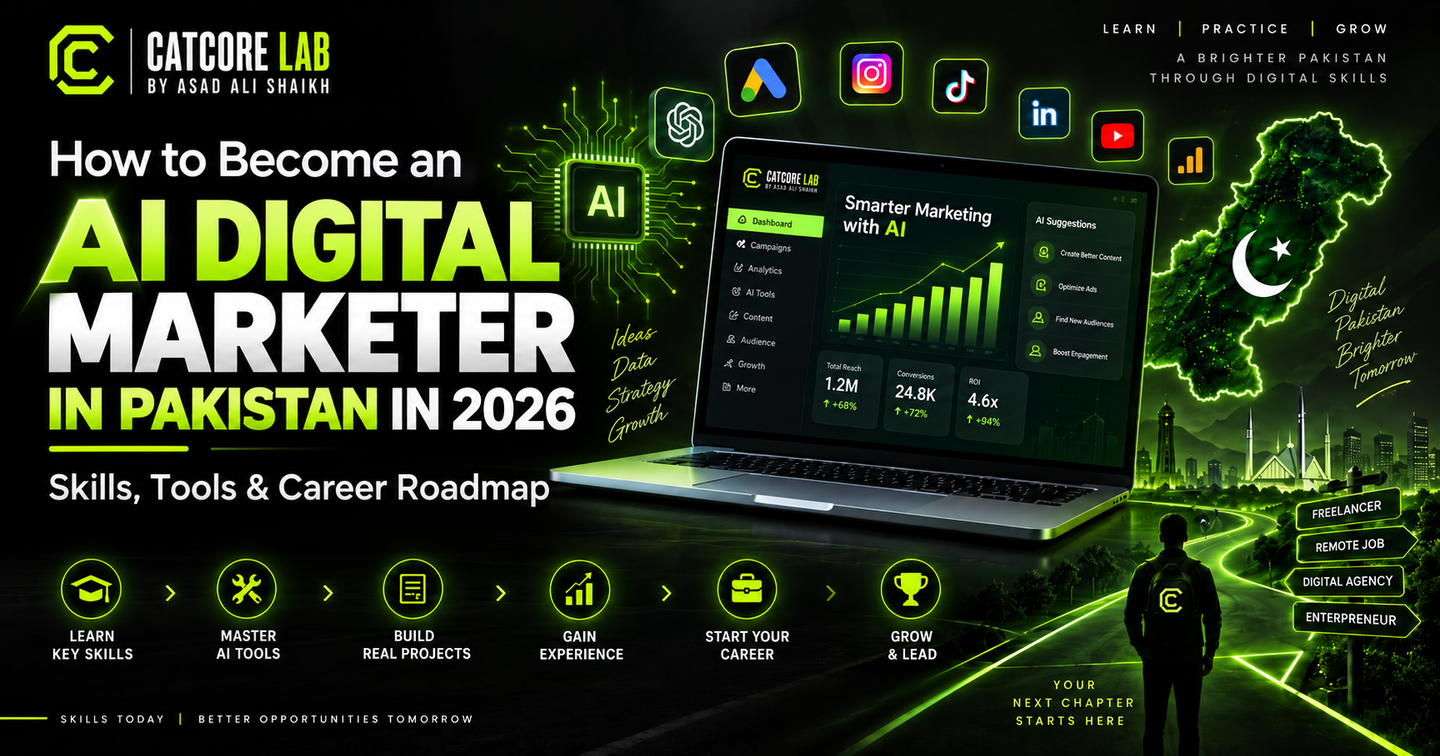
How Do You Become an AI Digital Marketer in Pakistan?
Short version: learn the basics first, social media, content, Meta Ads, Google Ads, SEO, analytics, conversion tracking, and once that starts to click, bring AI into the mix for research, content, analysis, whatever needs speeding up.
You don't need to be a programmer for any of this. Honestly, that's probably the most common wrong turn beginners take. An AI digital marketer is a marketer. AI is just the thing that helps them research faster, come up with more ideas, and skip some of the boring parts.
Also, knowing how to type a good ChatGPT prompt isn't the same skill as marketing. You still need to know the customer, the offer, the platform, what a campaign is even supposed to do. If anything, in 2026 the real skill is judgment: knowing what to ask AI, when it's actually helpful, and when its output is just... fine, but not good enough to use.
What Skills Does an AI Digital Marketer Need?
Nobody expects you to be great at all of this on day one.
Where people go wrong is treating each of these like its own island. In reality, a Meta Ads campaign sends someone to a landing page, that page needs tracking on it, and then someone has to sit down and actually read the results afterward. AI can pitch in at each of these steps, but somebody still needs to see the whole chain, not just their one piece of it.
Why AI Digital Marketing Matters in 2026
Marketing's always moved fast, but AI has pushed the pace up another notch. Stuff that used to take an afternoon now takes ten minutes.
Which sounds great, until you remember faster isn't the same as better.
AI can hand you ten ad ideas before you've finished your coffee, and none of them might actually land with the customer. It'll write you a polished landing page around an offer that's still, frankly, kind of weak. It'll summarize a campaign's data for you, someone still has to decide what that summary actually means for next week.
So marketers now need a slightly odd combination: real marketing sense, creativity, an analytical brain, and comfort with AI tools all at once. People who keep their own judgment while using AI will run circles around people who just copy whatever the tool spits out.
What Does an AI Digital Marketer Actually Do?
Stripped down, an AI digital marketer helps a business get attention, generate leads, close sales, and keep customers around, and uses AI to make some of that easier.
Maybe that's using AI to comb through hundreds of customer reviews for the same three complaints showing up again and again. Maybe it's brainstorming ad angles, drafting an email, comparing how two campaigns did, or turning a pile of research into something a client can skim in under five minutes.
But AI is only ever helping. The marketer's the one who has to answer the actual hard questions: who are we trying to reach, what problem are we solving, why us and not the competitor down the street, which platform even makes sense here, what should we test, are these leads turning into paying customers or not.
Think of AI as leverage. Not a stand-in for actually knowing what you're doing.
A Practical AI Digital Marketing Roadmap for Beginners
Try to learn this off random YouTube videos and you'll end up pulled in five directions, one video says learn SEO first, the next says forget that, start with Meta Ads, a third insists you should already be automating things with AI.
Easier to just go in order.
Step 1: Understand Marketing First
Before you open a single AI tool, figure out why people actually buy things in the first place.
Audiences, pain points, positioning, offers, funnels, the customer journey, none of it sounds exciting next to a shiny new AI app, but it's what everything else stands on.
Two marketers, side by side. One's memorized every button in Meta Ads Manager and still can't tell you why anyone should buy the product. The other doesn't know half the technical tricks but gets the customer completely and knows exactly what to say to them.
The second one wins, every time.
Tools change constantly. How people actually think doesn't change nearly as fast.
Step 2: Learn Content and Social Media
Once the customer part clicks, next is figuring out how businesses actually talk to people online, because it's not just posting three times a week and crossing your fingers.
You need hooks, storytelling, a feel for different content formats, some sense of how audiences behave, and an actual reason for including a call to action instead of just tacking one on. And honestly, you should be able to say why a given piece of content exists at all.
Some of it builds awareness. Some builds trust. Some quietly answers objections before anyone even asks them out loud. Some exists purely to get someone to message you or buy.
This is also where a lot of beginners need to unlearn judging everything by view count.
A video with 300,000 views can bring in exactly zero real business. A video with 5,000 views can bring in a handful of serious buyers. So the better question isn't "how many people watched this", it's "what did people do after they watched it."
Once you've got audiences and content down, paid advertising suddenly makes a lot more sense than it did before.
For Meta Ads, campaign objectives, audiences, creatives, budgets, lead gen, sales campaigns, retargeting, basic optimization, sure. But spend more energy on why you're picking a strategy than on memorizing where the buttons live.
Google Ads teaches something different: search intent.
Someone typing "best digital marketing course in Pakistan" into Google already wants something. Someone scrolling Instagram probably wasn't even thinking about a course until an ad interrupted their feed.
Both can end up as customers. But they're in completely different headspaces when they see your ad, and treating them the same is a mistake a lot of beginners make.
Step 4: Learn Analytics and Tracking
At some point you need to know if any of this is actually working.
CTR, CPC, CPM, conversion rate, cost per lead, cost per acquisition, ROAS, learn the basics of each. Get comfortable with pixels and website events and conversion tracking too, even if it feels dry.
Here's a scenario worth sitting with: one campaign brings in 100 leads at Rs. 300 apiece, another brings in 50 leads at Rs. 500 apiece. Glance at that and campaign one looks like the clear winner.
Except, what if the cheap leads only turn into two actual paying customers, and the pricier ones turn into ten?
Now campaign two is the one you actually want, and it isn't close.
That's one of the harder lessons in performance marketing to really absorb: cheap leads and profitable leads aren't the same thing, not even close sometimes. Good marketers look past the dashboard and ask what actually happened to the business afterward.
How Can AI Be Used in Digital Marketing?
Once the foundation's solid, this is where AI actually starts earning its keep.
Research
Good at sorting through customer reviews, competitor research, comments, surveys, audience questions, as long as you're feeding it real information instead of just asking it to guess what customers want.
Content and Copywriting
Useful for a first pass at headlines, ad copy, emails, landing pages, captions, video scripts. Saves time on the blank page. Publish that first draft untouched, though, and your brand starts sounding like every other brand that used the same prompt.
Creative Ideas
Genuinely handy for brainstorming hooks, visual concepts, campaign angles, different takes on one idea, so you're not staring at a blank page every single time you need a new angle.
SEO
Topic clustering, search intent, FAQs, content briefs, internal linking ideas, all fair game. Just know that pumping out three hundred generic AI-written articles isn't a strategy, even if it feels like progress while you're doing it.
Analytics
Can summarize reports, compare campaigns side by side, flag changes worth a second look. Someone still has to decide whether those changes actually matter or if it's just noise.
Automation
Handy for the repetitive stuff too, leads, CRM systems, follow-ups, reporting, especially once you're running more than one campaign or client at a time.
Wrong question: "how much of my job can AI do." Better one: "which repetitive tasks can I hand off so I've got more time left over for actual strategy."
Build a Portfolio, Not Just Certificates
Certificates aren't nothing, but they don't prove you can solve an actual marketing problem for an actual business.
Start building real projects early, even without a client. A social media strategy for a local restaurant. A Meta Ads campaign mapped out for an e-commerce store. Keyword research for some random business. A simple funnel sketched from scratch. None of it needs to be for pay.
What actually matters is being able to walk someone through your thinking afterward.
"I know Meta Ads" doesn't say much on its own. "Here's the audience I picked, how I structured the campaign, the angles I'd test, and why", that version, people actually believe.
Can You Learn Digital Marketing Without a Degree?
Yes. No specific degree required to get in here.
People land in digital marketing from business backgrounds, computer science, engineering, media, and plenty of places that have nothing to do with marketing at all. What matters more is whether you can actually show useful skills when asked.
A degree might open certain doors, fair enough, but this field is unusually hands-on compared to most. Know ads? Show a campaign. Know content? Show the writing. Know SEO? Talk someone through the research. Faking real ability here is genuinely hard.
Is Digital Marketing a Good Career in Pakistan in 2026?
Yes, especially if you're willing to keep adjusting as AI keeps changing the field under everyone's feet. A digital marketing career in Pakistan can take a lot of different shapes depending on what you gravitate toward.
Social media marketing, SEO, performance marketing, Meta Ads, Google Ads, content strategy, e-commerce marketing, analytics, marketing automation, plenty of directions here. Agency work, in-house at a brand, freelancing, or eventually your own thing.
You don't need to pick your lane on day one either. Get the fundamentals down, start touching real projects, and you'll usually figure out pretty naturally which part of this you actually like doing and happen to be decent at.
A Simple 90-Day Learning Plan
Month one: fundamentals, customer research, content, social media, basic SEO, and getting comfortable using AI just for research.
Month two: Meta Ads, Google Ads, funnels, analytics, conversion tracking, and actually build one practice campaign instead of only watching people build theirs.
Month three: stitch it together with AI. Try AI-assisted content, research, campaign ideas, light automation. Put together two or three portfolio pieces you can talk through without stumbling.
After 90 days you're not an expert. Nobody gets there in three months. But you'll have moved from just absorbing information to actually doing the thing.
Do You Need an AI Digital Marketing Course?
You can teach yourself, no question. There's more free material out there than any one person could get through in a lifetime.
The real problem people run into is knowing what to learn first and how the pieces are supposed to connect.
A structured AI digital marketing course in Pakistan makes sense if you'd rather have a clear path, real projects, and someone to check your work, instead of bouncing randomly between videos and tools hoping it adds up eventually.
At Catcore Lab, the point isn't teaching AI tools in a vacuum. It's tying together marketing fundamentals, advertising, content, analytics, and modern AI workflows so students actually see how the pieces fit, not just memorize each one separately.
Cat Core Lab’s next live batch starts on 12 December 2026. Enroll by 31 October 2026 to secure the Early Bird Fee of PKR 15,999; after the early bird offer ends, the course fee will increase to PKR 17,999.
View Course Details
Frequently Asked Questions
What is AI digital marketing?
Using AI alongside regular digital marketing, to help with research, content creation, advertising, analysis, and automation.
Is AI digital marketing a good career in Pakistan?
Yes, particularly if you pair real marketing knowledge with AI, creativity, and some analytical thinking.
Do I need coding to become an AI digital marketer?
No. Most roles don't ask for it. Some technical comfort helps here and there, but it's not a requirement to get started.
How long does it take to learn digital marketing?
The basics, a few months. Getting genuinely good, that takes hands-on work and years of staying current, honestly.
Will AI replace digital marketers?
It'll change how the job gets done day to day, but businesses will still need people who actually understand customers, strategy, creativity, and results. Marketers who learn to work with AI instead of against it will probably come out ahead.
Final Thoughts
If you're trying to figure out how to become a digital marketer in Pakistan in 2026, don't start by trying to learn every AI tool that crosses your feed.
Start with marketing.
Understand customers, offers, content, advertising, analytics. Learn how businesses actually earn attention, and how that attention eventually turns into money.
Then let AI take over the boring parts. Use it to research. Use it to explore ideas faster. Use it to cut the repetitive work down. Use it to make sense of a mess of data.
Just don't hand it your judgment.
As AI makes it easier for everyone to pump out content and campaigns, the edge stops being about who makes more of it. It's about who knows what's actually worth making, why it matters, and what comes next.