SEO
What Is SEO? A Complete Beginner's Guide for 2027
Learn what SEO is, how it works, and its main types. Explore keyword research, SEO tools, AEO, GEO, and the latest SEO trends for beginners in 2027.
Read article
What is Agentic AI? Discover how AI agents work, real-world examples, benefits, career opportunities in Pakistan, and how beginners can get started.
Imagine running an online business where customer inquiries arrive throughout the day. Some customers want product recommendations. Others need delivery updates, quotations, or help completing an order.
Normally, someone from your team has to read each message, check the relevant information, decide what to do, and respond. Even when you use a traditional chatbot, many of these tasks still require human intervention.
Now imagine an AI system that can understand a customer's request, check your product database, retrieve relevant information, prepare a response, and update your customer relationship management (CRM) system, all within rules you have approved.
That is the promise of Agentic AI.
For years, the conversation around artificial intelligence focused on what AI could generate: articles, images, code, emails, and presentations. Agentic AI introduces another important capability: using AI to work toward goals and take actions, rather than simply produce answers.
But what exactly is Agentic AI? How is it different from generative AI? Can beginners learn it? And what opportunities could it create for students, developers, freelancers, and businesses in Pakistan?
This guide explains the technology in plain English, examines practical applications, and outlines what it takes to start building AI agents.
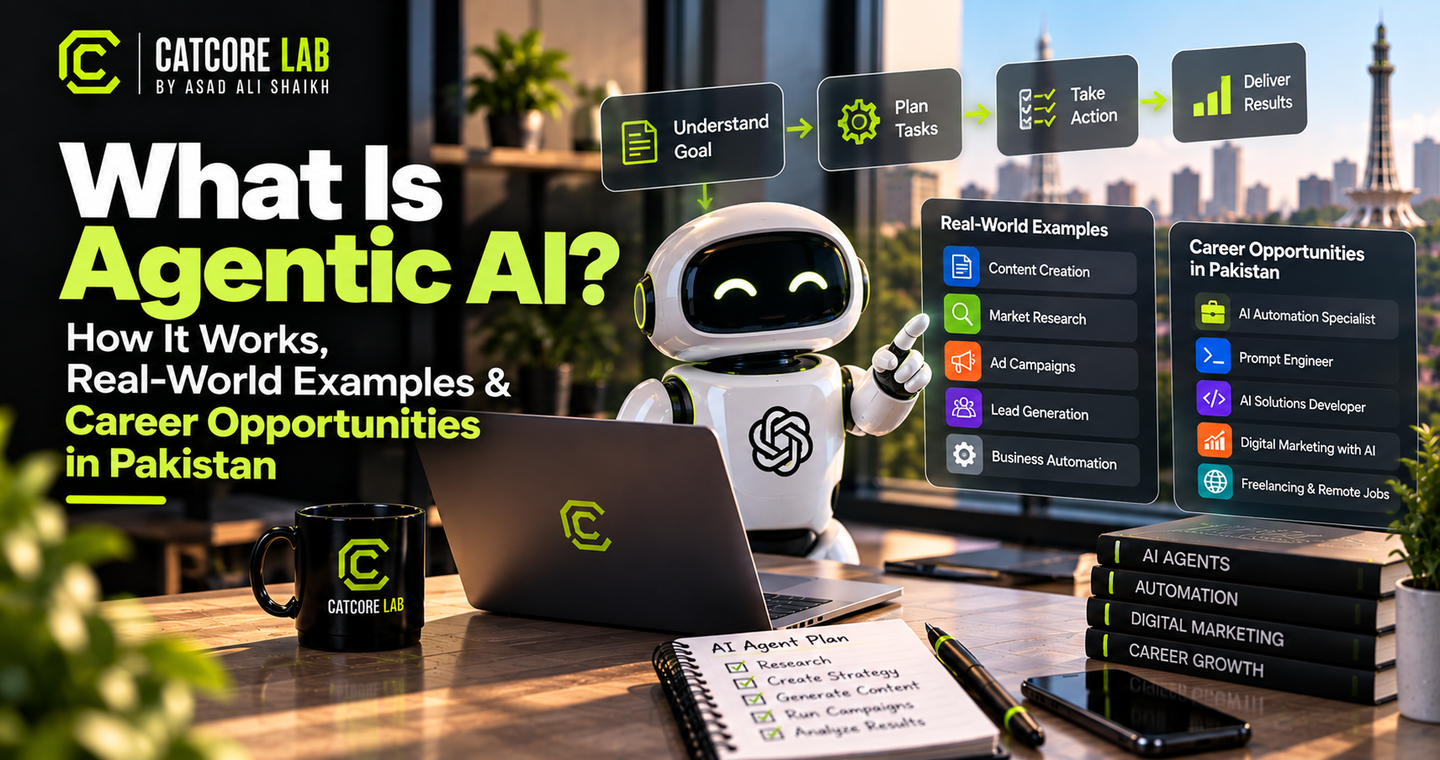
Agentic AI is an approach to artificial intelligence in which AI systems can interpret goals, plan tasks, use tools, make context-dependent decisions, and take actions with a defined level of autonomy.
Instead of responding to every instruction as an isolated request, an agentic system can work through several connected steps toward an intended outcome.
For example, a conventional AI chatbot might explain how to organize your weekly meetings.
An AI agent connected to an approved calendar system could inspect available time slots, propose a meeting schedule, identify conflicts, and create calendar invitations once the necessary permissions and approvals are in place.
The distinction is important.
A traditional AI interaction often ends with an answer. An agentic workflow may continue until a task has been completed, a decision requires human approval, or the system encounters a defined limit.
According to Google Cloud, agentic AI combines capabilities such as perception, reasoning, planning, action, and evaluation to accomplish tasks with reduced human intervention.
However, autonomy does not mean unlimited independence. Well-designed agentic systems operate within permissions, security controls, and human oversight.
Think of the difference between asking someone for advice and assigning them a task.
If you ask an AI assistant, “How should I organize my customer inquiries?”, it may give you a useful list of recommendations.
If you provide an appropriately configured AI agent with the goal, “Organize incoming customer inquiries according to urgency and prepare responses,” the agent may be able to carry out the workflow using connected software.
Generative AI helps create an answer. Agentic AI can use intelligence, tools, and defined workflows to help accomplish a goal.
That does not mean one is inherently better. They solve different problems, and many agentic applications depend on generative AI models to function.
Agentic AI might sound complicated, but its basic working process is surprisingly understandable.
Most agentic systems combine a reasoning model, access to relevant information, connected tools, and a workflow for deciding what to do next.
Consider an AI agent designed to help an online store manage customer inquiries.
Every useful agent starts with a clear objective.
For example:
“Review new customer inquiries, identify product-related questions, and prepare accurate responses using our product catalog.”
The agent needs to understand both the objective and its limitations.
Can it send messages directly? Should it only prepare drafts? What information can it access? When must a human review its work?
These questions should be answered before the agent begins operating.
The agent retrieves information needed to complete its task.
For an online store, this might include:
The quality of this information matters. An agent connected to outdated product information can produce incorrect recommendations, even when its reasoning appears convincing.
Rather than immediately producing a response, the agent can determine which steps are required.
For example:
A more advanced system may revise this plan when it encounters missing information or unexpected results.
This is where agentic AI becomes especially useful.
An AI agent may interact with software through APIs, databases, approved integrations, or other authorized tools.
Depending on its configuration, it could retrieve records, update a spreadsheet, create a support ticket, draft an email, or trigger another workflow.
The AI model provides reasoning and language capabilities. The connected tools provide the ability to interact with external systems.
After completing an action, the agent can inspect the result.
Did the CRM update succeed? Was the requested information found? Did an API return an error?
If something fails, the agent may retry, select a different permitted approach, or escalate the issue to a human.
This process of planning, acting, observing, and adjusting is central to many agentic workflows.
Importantly, the system does not automatically become more intelligent after every task. Long-term improvement generally requires explicitly designed memory, feedback, evaluation, or model-update mechanisms.
Agentic AI and generative AI are related, but they are not interchangeable.
Generative AI focuses on creating content, including text, code, images, and other outputs.
Agentic AI focuses on using AI capabilities to pursue objectives through decisions, tools, and actions.
Here is a practical comparison.
| Feature | Generative AI | Agentic AI |
|---|---|---|
| Primary purpose | Generate or transform content | Complete goal-oriented workflows |
| Typical interaction | Prompt followed by a response | Goal followed by multiple actions |
| Planning | May suggest plans | Can plan and execute steps |
| Tool usage | Optional | Commonly central to operation |
| Autonomy | Often limited in basic applications | Configurable, potentially higher |
| Example | Draft a customer email | Retrieve customer details, draft an email, and submit it for approval |
| Human involvement | Usually prompt-driven | Can operate between approval points |
Imagine a digital marketing agency preparing a monthly client report.
Using generative AI, a marketer could provide campaign data and ask for a performance summary.
Using an agentic workflow, a connected system might retrieve data from approved analytics platforms, compare performance against agreed targets, identify unusual changes, prepare a report, and send it to the account manager for review.
The second workflow requires more than language generation. It needs integrations, data handling, decision logic, error management, and appropriate permissions.
The distinction is not absolute. Modern AI assistants may also use tools and perform multi-step tasks. What matters is how the entire system is designed and how much control it has over execution.
The two terms are closely related, which is why they are frequently used together.
An AI agent is a software component designed to perceive information, make decisions, and perform tasks toward a goal.
Agentic AI is the broader approach to designing AI systems with goal-directed, adaptive behavior.
An agentic system may contain a single AI agent or several agents working together.
For example, a content production system could include a research agent, a writing agent, and a quality-review agent. Each performs a defined role, while a coordinating workflow manages their work.
However, multiple agents are not always necessary.
For many business processes, one well-designed agent with a small set of reliable tools is simpler, cheaper, and easier to maintain.
The best way to understand Agentic AI is to examine the problems it can solve.
The following examples describe practical applications that can be developed using suitable integrations and controls. They are not claims that every AI tool already provides these capabilities out of the box.
Imagine a clothing store receiving hundreds of inquiries about sizes, colors, stock availability, and deliveries.
An AI agent connected to the store's systems could retrieve product details, identify relevant items, prepare personalized recommendations, and create support tickets for unresolved questions.
Why it matters: Businesses can reduce repetitive administrative work while allowing human representatives to focus on complex customer issues.
Marketing teams spend considerable time collecting information from different platforms.
An appropriately connected agent could retrieve campaign metrics, organize them into reports, flag performance changes, and suggest questions worth investigating.
For example, if advertising costs increase while sales remain unchanged, the system could highlight that pattern for a marketer.
It should not automatically make major budget changes without agreed limits and oversight.
Why it matters: Marketers can spend less time assembling reports and more time interpreting results.
A service business may manage dozens of appointments every week.
An agent connected to its booking system could check availability, suggest appointments, identify scheduling conflicts, and send confirmations after approval.
Why it matters: It reduces repetitive coordination while helping businesses maintain organized schedules.
Developers can use agentic coding systems to work through certain software tasks.
A coding agent might inspect an existing project, propose changes, edit files, run tests, and identify errors.
For example, a developer could request a new contact form with input validation. A suitably equipped agent might generate the relevant code, integrate it with the application, and run available tests.
However, code should still undergo review, especially when it affects authentication, payments, sensitive information, or production systems.
Why it matters: Agentic tools can accelerate selected development tasks without replacing sound engineering practices.
A sales team may receive leads through websites, forms, and customer inquiries.
An agent could classify incoming leads, check for duplicate records, prepare follow-up drafts, and update CRM information.
Any automated outreach should respect consent, privacy requirements, and communication policies.
Why it matters: Sales teams can improve administrative consistency and follow-up processes.
Educational institutions can use AI agents to help organize learning materials, retrieve course information, generate practice exercises, and guide students through structured tasks.
A learning assistant might identify topics a student needs to practice and recommend exercises based on their progress.
Why it matters: It can support personalized learning without replacing the role of instructors.
A business may need to reconcile information across spreadsheets, databases, and internal applications.
An AI agent could identify missing records, compare approved data sources, flag inconsistencies, and prepare an exception report.
Why it matters: Structured agentic workflows can reduce manual effort in recurring operational tasks.
Pakistan has a substantial ecosystem of freelancers, software developers, online sellers, service providers, and small businesses.
Many of these businesses face a common challenge: important processes depend on repetitive manual work.
Think about a small online retailer.
Someone must respond to inquiries, update records, coordinate deliveries, prepare reports, and communicate with customers.
A large company might build dedicated teams for these responsibilities. A smaller company often relies on a few employees handling multiple roles.
Agentic AI creates opportunities to automate parts of these workflows.
E-commerce businesses: Product inquiries, order-status retrieval, and customer support assistance.
Digital marketing agencies: Reporting, campaign data organization, and client communication workflows.
Software companies: Development assistance, testing support, and documentation.
Educational institutions: Student support, learning resources, and administrative workflows.
Professional service firms: Document preparation, scheduling, and structured information retrieval.
However, businesses should evaluate whether agentic AI is genuinely necessary.
A simple form, spreadsheet formula, or conventional automation may be more reliable and less expensive for a predictable task.
Agentic AI becomes particularly interesting when a workflow involves changing information, multiple decisions, and situations that cannot be handled effectively through fixed rules alone.
Yes, potentially. But the opportunity lies in solving real business problems, not simply adding “AI expert” to a freelancer's profile.
For example, imagine a freelancer working with an international e-commerce business.
The client has a recurring problem: customer inquiries arrive through several channels, and staff members spend hours sorting them.
Instead of offering a generic chatbot, the freelancer could propose a carefully scoped solution that classifies inquiries, retrieves information from an approved knowledge base, and prepares responses for review.
The freelancer's value would come from understanding the business process, designing a reliable workflow, implementing the required integrations, and maintaining the solution.
These are potential service categories, not guaranteed sources of freelance income.
Clients generally care more about reliability, measurable business value, and security than the number of AI tools a freelancer knows.
Agentic AI is a relevant area for people interested in software development, automation, applied artificial intelligence, and business technology.
However, it is important to understand that Agentic AI is a skill area, not necessarily a standalone entry-level job title.
Some employers may advertise roles involving AI agents, LLM applications, automation engineering, or AI application development rather than using the exact title “Agentic AI Developer.”
Students can therefore benefit from developing transferable technical skills instead of learning only one framework.
| Career direction | Skills to focus on |
|---|---|
| AI Application Developer | Programming, APIs, LLM integration |
| AI Automation Developer | Workflows, integrations, error handling |
| Full-Stack Developer with AI Skills | Frontend, backend, databases, deployment |
| LLM Application Engineer | Prompt design, retrieval, evaluation, tools |
| AI Solutions Developer | Business analysis, system design, security |
| Freelance AI Integration Specialist | Client workflows, APIs, testing, maintenance |
These roles have different entry requirements. Some demand strong programming and software engineering experience.
Learning Agentic AI fundamentals can help you explore these pathways, but completing a short course alone does not guarantee employment or professional readiness.
Not necessarily at the beginning.
People can understand the principles of AI agents, experiment with visual workflow builders, and create limited automation prototypes without extensive programming knowledge.
But there is an important difference between building a demonstration and deploying a reliable production system.
Professional development may require:
A beginner can start with no-code or low-code tools and gradually learn technical development.
For students who want to build customized AI applications, programming is a valuable long-term investment.
You do not need to begin with a complex multi-agent system.
In fact, one of the most effective ways to learn is to build a small, clearly defined project.
Select a task with a clear beginning and end.
For example:
“Build an assistant that answers questions using a small product catalog and creates a support request when it cannot find an answer.”
This is better than trying to create an AI system that manages an entire business.
Understand how language models work at a practical level, including prompts, context, structured outputs, and limitations.
Then explore how software applications exchange information through APIs.
Beginners may experiment with visual automation platforms, while developers can explore programming frameworks and AI development tools.
Examples worth investigating include:
These tools serve different purposes. You do not need all of them to build your first project.
Start with a small, controlled knowledge source such as a product catalog or frequently asked questions document.
Make sure the agent can distinguish between information it can verify and information it does not know.
Give the agent a limited capability, such as creating a draft support ticket.
Avoid giving it unrestricted access to important systems.
Test straightforward requests, ambiguous requests, missing information, incorrect inputs, and tool failures.
For example, what happens if a customer asks about a product that is unavailable?
A well-designed agent should not invent stock availability.
Before enabling actions that could affect customers, finances, or sensitive records, introduce approval checkpoints.
An agent that prepares a correct draft is useful. An agent that sends an incorrect message to hundreds of customers can create a serious business problem.
Once the prototype works reliably, deploy it in a controlled environment.
Monitor errors, execution costs, response quality, and user feedback.
Building an agent is only the beginning. Maintaining it is part of the engineering responsibility.
Agentic AI becomes much more useful when combined with broader software development knowledge.
Languages such as Python and JavaScript help developers build applications, integrate APIs, and implement business logic.
Understanding frontend and backend development allows you to create complete applications rather than isolated AI demonstrations.
Many useful agents need to retrieve or update structured information.
Database fundamentals help you build systems that work with real application data.
APIs allow AI applications to communicate with other services.
This is essential for connecting an agent to calendars, business systems, or other approved tools.
Agentic systems may produce different results for similar requests.
Developers need ways to test whether an agent is accurate, reliable, secure, and appropriately constrained.
Prompt injection, excessive tool permissions, sensitive-data exposure, and unauthorized actions are important risks.
Security should be included from the beginning rather than treated as a final feature.
Agentic AI can offer meaningful advantages when applied to suitable tasks.
Reduced repetitive work: Teams may spend less time moving information between systems and performing routine administrative steps.
More flexible workflows: Agents can respond to certain changing conditions that rigid scripts may not handle effectively.
Better use of connected information: Properly configured systems can retrieve relevant data from multiple authorized sources.
Assistance with complex tasks: An agent can divide larger objectives into manageable steps.
Opportunities for new applications: Developers can build software that combines natural-language interfaces with useful actions.
These benefits depend on implementation quality. Poorly designed agents can introduce complexity, costs, and risks without delivering meaningful value.
Despite its potential, Agentic AI is not a universal solution.
Language models can misunderstand instructions or generate inaccurate information.
When an agent can take actions, those mistakes may have consequences beyond an incorrect text response.
An agent with access to customer data, business systems, or sensitive documents needs strict permissions.
Developers must consider authentication, access control, logging, and data protection.
Agentic workflows may use multiple model calls, external APIs, databases, and hosting infrastructure.
Costs can rise as workflows become more complex or run frequently.
When several tools and decision stages interact, determining why something failed can become difficult.
Financial transactions, account changes, sensitive communications, and other high-impact actions often require human approval.
The goal of Agentic AI should be controlled, useful automation, not automation without accountability.
IBM Research has also emphasized the importance of choosing between simple AI calls, guided assistants, and autonomous agents based on the actual requirements of a task. More autonomy is not automatically better.
Agentic AI has the potential to influence how businesses develop software, manage information, and automate operations.
For Pakistan, several opportunities are worth watching.
Software developers may increasingly build AI capabilities into websites and applications.
Digital agencies may expand their offerings to include AI-assisted workflows and business integrations.
E-commerce businesses may experiment with smarter customer support and operational systems.
Freelancers may develop specialized services around automation and AI application development.
Educational institutions may place greater emphasis on practical AI skills alongside programming fundamentals.
However, these are opportunities and possible directions, not guaranteed market outcomes.
Widespread adoption will depend on costs, internet and software infrastructure, technical skills, trust, security, and whether businesses can demonstrate meaningful returns.
For learners, the most practical approach is to develop skills that remain useful even as specific AI tools change.
That means learning how to understand problems, build software, work with data, and evaluate the results.
Understanding Agentic AI is a useful first step. Building something with it is where the learning becomes practical.
At Catcore Lab, our Agentic AI & Full-Stack Development program is designed for students, beginners, aspiring developers, and people who want to turn their ideas into working applications.
The eight-week, live online program introduces learners to AI-assisted development, responsive websites, databases, APIs, AI workflows, testing, and deployment.
The emphasis is on developing practical skills through guided projects rather than simply memorizing tools and terminology.
The program is taught by Rida Rajani, a full-stack developer, and is structured to begin with foundational concepts.
No previous coding background is required, although learners should be prepared to practice between classes.
Explore the Agentic AI & Full-Stack Development Course to review the curriculum, current fee, schedule, and enrollment requirements.
Agentic AI refers to AI systems designed to work toward goals by planning tasks, using tools, making decisions, and taking permitted actions. Unlike a basic chatbot that primarily responds to prompts, an agentic system can carry out connected steps within an authorized workflow.
An AI customer support agent is one example. It can retrieve approved product information, identify a customer's question, prepare a response, and create a support ticket. Its exact capabilities depend on its software integrations and permissions.
Generative AI primarily creates outputs such as text, images, and code. Agentic AI uses AI capabilities, tools, and decision-making workflows to accomplish goals. Agentic systems frequently use generative AI models as part of their architecture.
Not exactly. An AI agent is an individual system capable of performing goal-directed tasks. Agentic AI refers more broadly to the capabilities and architectural approach behind autonomous, goal-oriented AI systems, which can involve one or multiple agents.
Yes, you can learn the concepts and experiment with simple visual automation tools without prior coding experience. However, building customized, secure, production-ready AI agents generally benefits from programming, API, database, and software engineering skills.
Agentic AI may help freelancers develop services involving business automation, customer support, reporting, and AI application integrations. Success depends on practical skills, project quality, client requirements, and the value delivered.
No. Agentic AI is an approach to building AI systems, not a feature exclusive to one product. Developers can use different language models, frameworks, and software integrations to create agentic applications.
Agentic AI may automate portions of software development, but reliable applications still require requirements analysis, architecture, security, testing, maintenance, and human judgment. Developers who learn to work effectively with AI tools may find new opportunities as software practices evolve.
Not always. Traditional automation is often more predictable and cost-effective for fixed, repetitive processes. Agentic AI can be useful when tasks involve uncertain inputs, flexible decisions, and changing conditions that are difficult to handle with predefined rules alone.
Start by understanding AI agents, language models, APIs, and basic workflows. Build a small practical project, test it carefully, and gradually develop programming and full-stack skills. Structured training can help beginners follow a guided learning path.
Artificial intelligence has already changed how people write, research, design, and develop software.
Agentic AI extends that conversation from generating information to using information in order to accomplish tasks.
Its real significance is not that an AI system can operate independently. It is that businesses and developers can create software capable of handling more sophisticated workflows while maintaining appropriate control.
For students and professionals in Pakistan, this is an opportunity to learn how modern AI applications are designed and built.
Start with the fundamentals. Understand the limitations. Build a small project. Learn how software systems communicate. And focus on solving problems that matter.
Because the most valuable AI skill is not knowing how to describe the latest technology.
It is knowing how to use that technology to build something useful.
Ready to move from AI concepts to practical development?
Explore Catcore Lab's Agentic AI & Full-Stack Development Course
Learn what SEO is, how it works, and its main types. Explore keyword research, SEO tools, AEO, GEO, and the latest SEO trends for beginners in 2027.
Read articleCan you learn digital marketing in 2 months? Explore practical skills, an 8-week roadmap, student reviews, and Catcore Lab's AI Digital Marketing Course.
Read articleDiscover digital marketing salary in Pakistan for 2026–2027, including fresher, specialist, SEO, performance marketing and senior-level earnings.
Read article